Faraday Shield Effectiveness
Vendors should state effectiveness in dB, not implying to completely block all signals.

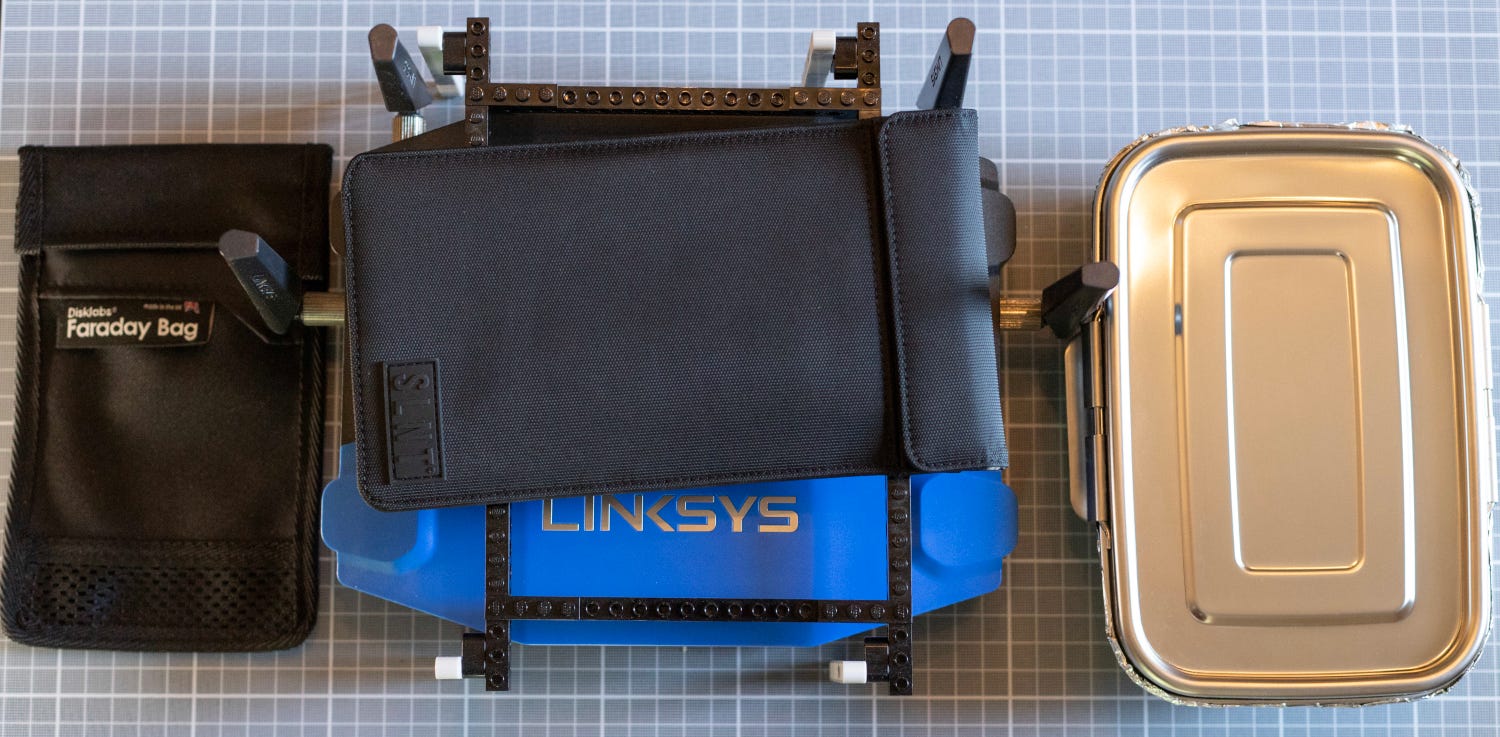
Wireless signals have become ubiquitous for phones, laptops, and accessories. If the device itself is not trusted to block the signals, an external Faraday shield can be used. There are a number of cheap and more expensive commercial offerings. Most of them claim to block all common wireless protocols, which is not the case. Regardless, each shield should be tested before use, as well as for wear and tear.
I started to test some cheaper options which turned out to perform really badly, especially for WiFi and Bluetooth. I tested Bluetooth by connecting wireless speakers and seeing if the music would stop when the phone was placed in the sleeve. I tested WiFi by sending messages to the phone over WiFi and listening for the notifications. I then moved on to test more expensive options from Disklabs and SLNT. There are many other brands to chose from.
At first they seemed to pass all the tests, but then I increased the difficulty. I had an old Linksys 1900ACS at hand, and tried to see what distance and relative position/rotation would yield the worst performance from the sleeves. They could no longer consistently block the signals, just attenuate them.
The comparison is not at all scientific. Hopefully it will inspire someone else to do a more rigorous test of a wider set of products. The test setup consists of the router with a Lego scaffolding to avoid the phone/shield being in direct contact. The phone used for the testing was a Google Pixel 7 Pro, running a custom app to measure the WiFi signal strength. The app uses the Android WifiManager’s getScanResults, which returns a list of access points, including their levels in dBm. For the results I recorded the number of access points seen, the strongest individual level, and the sum of all observed levels. Measuring from the outside of the shield, and without other signals interfering, would also be interesting and hopefully someone with an EMC chamber can do that.
Some time was spent finding the worst possible position of the phone with the different shields, then the experiment was run five times for each shield, with some variations. Each run had multiple measurements and the worst of these was recorded. The table shows the worst (max) and best (min) runs.
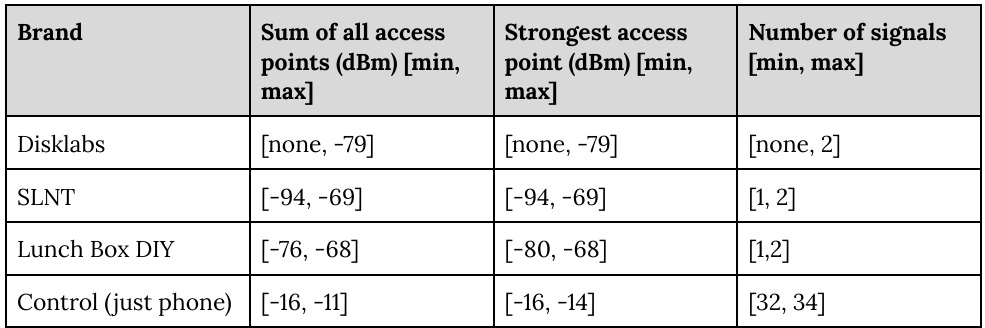
Disklabs had the only run where no signal was detected. SLTN had a -94 dBm run. Given the lack of data and rigor there is no clear winner. Interestingly, the worst runs of SLNT and the DIY are also similar. While experimenting all three had runs where no signal was detected. The DIY performed better with tinfoil, but the performance appeared to deteriorate with use. For Disklabs and SLNT how the lids were closed affected the performance.
The test WiFi was transmitting at both 2.4GHz and 5GHz. Looking at this after the tests were run, the 5GHz signal was both the strongest signal without a shield, and the signal present if only one access point was visible.
Raymond EMC, markets their QuietBags to have a “shielding effectiveness of 95dB @ 2.5GHz”. That is a claim that can be tested, unlike the vendors implying to completely block all the common protocols. Even better would be to have a table with effectiveness at different frequencies.
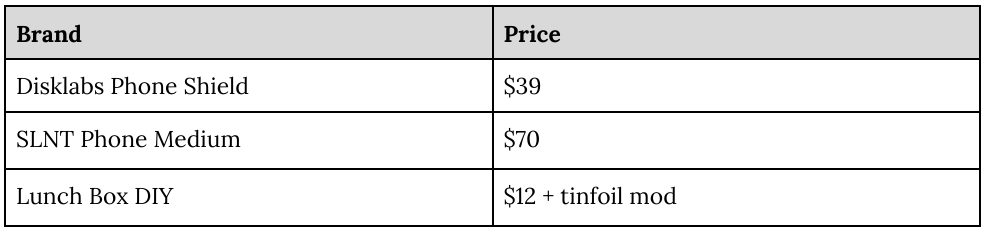
If we take the difference between the max signal for each shield and the control, the approximate rating would be Disklabs: ~65dB, SLNT: ~55dB, DYI: ~54dB. Again this is not at all rigorous and also not comparable to Raymond EMC since this test used both 5GHz and 2.4GHz.
Make sure to test your shields before use, and think of these as attenuators rather than blockers. Consider the frequencies of the protocol you want to block, as well as which transceivers and receivers are in scope.
If you think the tests were sloppy, do it better and share the results!